Picturing God
From Philosophy of Religion to Social Philosophy
This short exercise asks you to notice the words and images that come to mind when you think about God — and then to consider how those images might connect to beliefs about justice and society. This thought experiment is not an assessment, and there are no predetermined or evaluated answers. Your responses stay on this device.
Part 1: Fill in the blank
Fill in each blank with the first word or words that come to mind. Don't overthink it.
Part 2: The image
Part 3: Consistency check
Part 4: Reflection reading
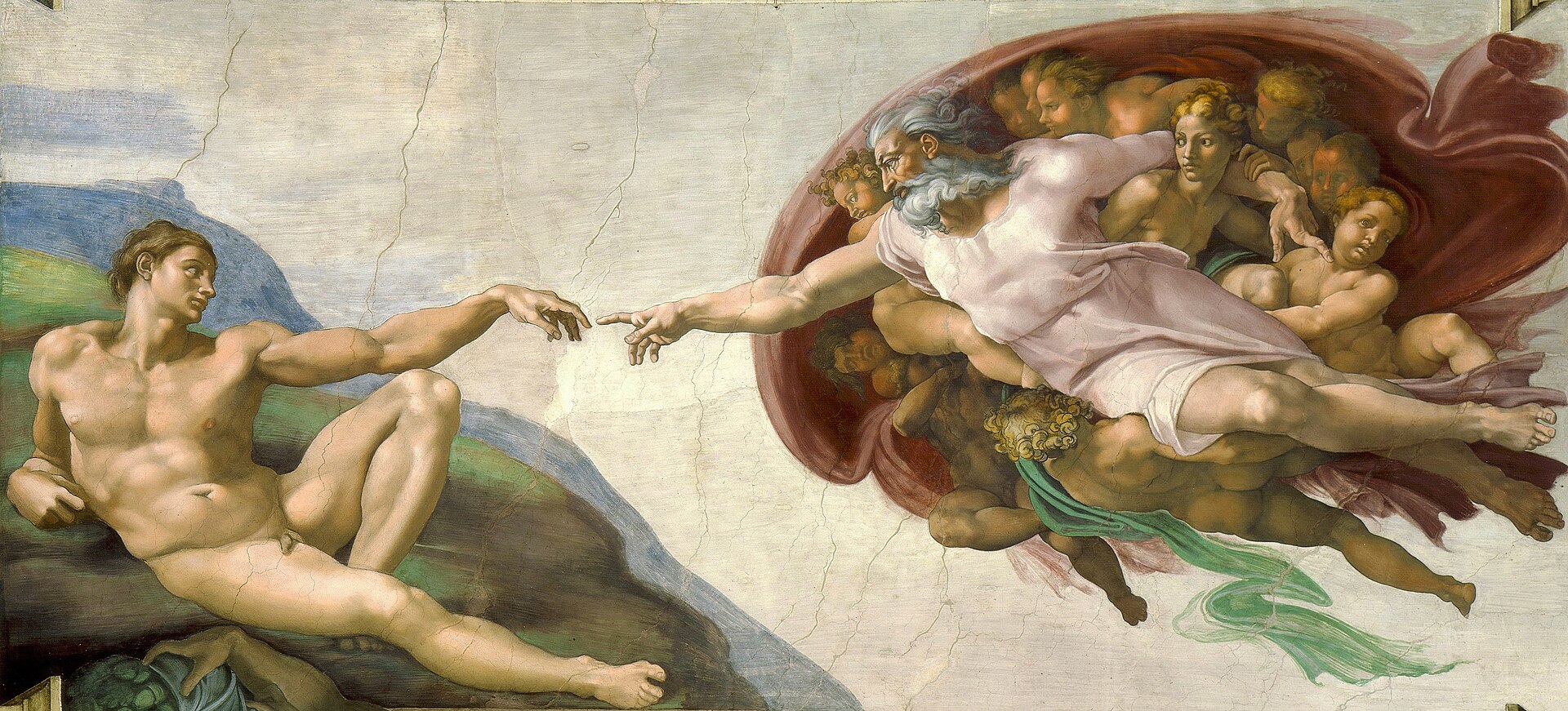
Image unavailable — see Michelangelo's Creation of Adam (detail), Sistine Chapel.
Look at this image before reading on. Is this God male? What in the image tells you so? Does this match the image you described in Part 2?
Though some claim that God has no sex — is neither male nor female — God is nevertheless routinely portrayed in image and language as male, a father. Feminist philosophers argue that the way we conceive of God has influenced our thinking about the rights owed to men and women.
In Beyond God the Father (1973), radical feminist philosopher Mary Daly argued that the symbolic representation of God as male — "as a great patriarch in heaven, rewarding and punishing according to his mysterious and seemingly arbitrary will" — functioned to reinforce the oppression and marginalization of women and others with less power in society. According to Daly, male-centered religion conceptually upholds oppressive "social structures" such as male control of females. "The symbol of the Father God," wrote Daly, "spawned in the human imagination and sustained as plausible by patriarchy, has in turn rendered service to this type of society by making its mechanisms for the oppression of women appear right and fitting. If God in 'his' heaven is a father ruling 'his' people, then it is in the 'nature' of things and according to divine plan and the order of the universe that society be male-dominated."
For context: This is not only a feminist characterization. Masculine language for God runs throughout the biblical texts—for example, Ephesians 4:6, 1 Corinthians 8:6, Luke 11:1–4, Psalms 68:5, Ephesians 1:3, and Isaiah 64:8 all address or describe God as "Father." The tradition's own language is overwhelmingly paternal.
A related but distinct point: 1 Corinthians 11:7–9 goes further, describing man as "the image and glory of God" and woman as "the glory of man," and stating that woman was created for man. Augustine and Aquinas later argued that woman's creation was for the purpose of bearing children and assisting man's "intellectual operation" (Augustine, The Literal Meaning of Genesis IX.5; Aquinas, Summa Theologica I.92). These texts have been used for centuries to support the view that women are naturally subordinate—which is precisely the pattern Daly calls the "God of Explanation."
A contemporary image: 'God is a Woman'
In 2018, Ariana Grande released the song "God is a Woman." She sings that her sexual power will make her lover believe "God is a woman." Grande explained that the song is about "sexual female empowerment & how women are literally everything & the universe is inside of us." The music video includes a recreation of Michelangelo's Creation of Adam, with Grande as God, reaching toward a Black woman as Adam.
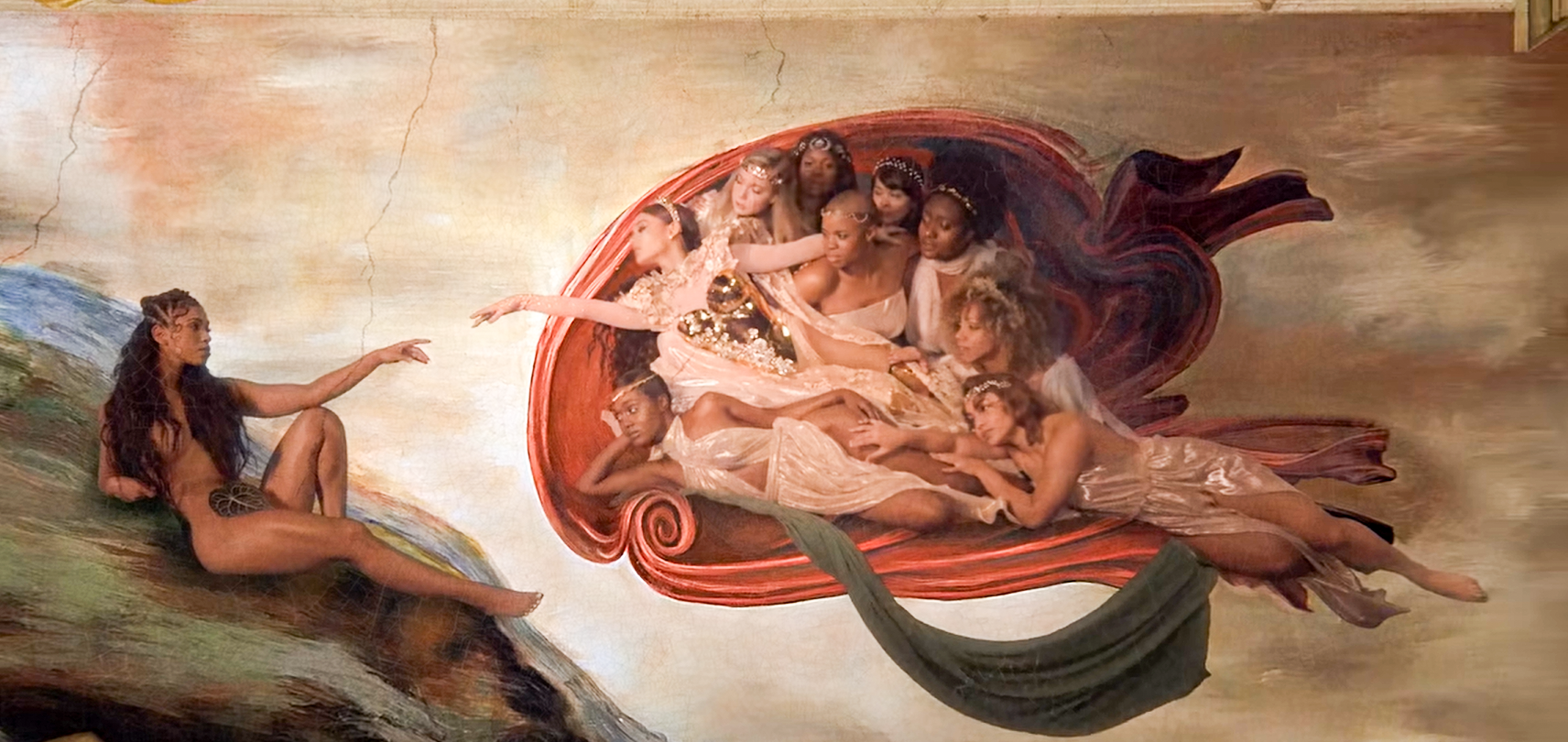
Image unavailable — Still from Ariana Grande's 'God is a Woman' music video (2018).
The Christian Broadcasting Network criticized this, stating that "Jesus makes it very clear in scripture that God is to be viewed as a father, not a mother," and cited verses such as Luke 11:1–4 to support this. This criticism reflects a widespread view among many Christians that masculine language for God is not merely customary but required.
Grande's claim isn't just a theological statement—it's a claim about power, sexuality, and who gets to image the divine.
Part 5: Social inequality prompt
Think of a social inequality you've personally witnessed or that's prominent in the news right now (for example: poverty, sexism, racial injustice, disability exclusion).
Now consider how someone might invoke God or divine providence when talking about it. For each statement below, mark what you think it mainly does.
Explains the situation = offers a reason things are the way they are. Rationalizes it = makes the inequality seem acceptable or justified. These can overlap; mark what you think the statement mainly does.
Part 6: The key reflection
If you marked a statement as "explains the situation" rather than "rationalizes it," what would have to be true for a sincere explanation to become a rationalization in practice?
Mary Daly called two of these patterns the "God of Explanation" and the "God of Otherworldliness." Naming them is not the same as rejecting belief in God — Sojourner Truth, Malcolm X, and Rev. Dr. Martin Luther King Jr. all opposed these patterns from within religious commitment.
Closing context
Philosophy of religion asks questions like whether or not God exists and why, if God does exist, evil is permitted. Social philosophy takes up broader questions about human society and the distribution of power. When directed at religion, social philosophy asks: How do religious beliefs shape our beliefs about what constitutes a just society? In what ways do religious beliefs foster attitudes that facilitate social transformation — and in what ways might religious belief be used to uphold social injustice?
Folk singer and labor activist Joe Hill wrote "The Preacher and the Slave" (1911) criticizing the tendency of preachers to tell those suffering injustice that their suffering will end after life is over: "You will eat… In that glorious land in the sky…. You get pie in the sky, when you die." Near the end of the song, Hill called for working people to find strength in human solidarity and to work together, in the present, to bring justice to earth. Karl Marx argued that religion gave oppressed people "illusory happiness" in place of "real happiness." For him, criticizing religion was a way to liberate human beings and direct them to remedy rather than rationalize injustice.

Image unavailable
Not everyone who criticized the use of religion to rationalize injustice rejected belief in God. Abolitionist and suffragist Sojourner Truth — a Christian — spoke out against the use of religion to justify women's oppression.
Image unavailable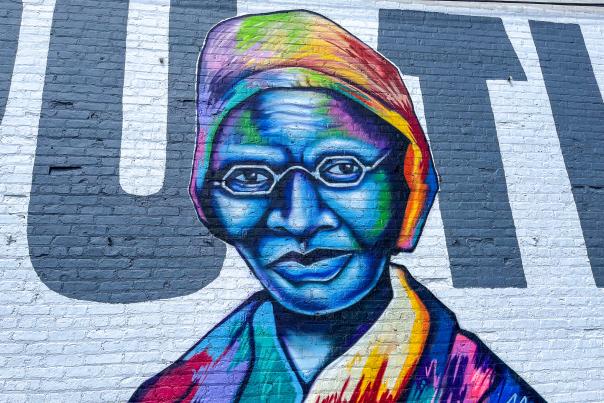
Rev. Dr. Martin Luther King Jr. lived his life a committed Christian, yet he too criticized organized religion, and Christianity specifically, for its overemphasis on the "hereafter." In his last speech, "I've Been to the Mountain Top," on April 3, 1968, the day before he was assassinated, King told a group of striking sanitation workers: "It's alright to talk about 'long white robes over yonder,' in all of its symbolism. But ultimately people want some suits and dresses and shoes to wear down here. It's alright to talk about 'streets flowing with milk and honey,' but God has commanded us to be concerned about the slums down here, and his children who can't eat three square meals a day. It's alright to talk about the new Jerusalem, but one day, God's preachers must talk about the new New York, the new Atlanta, the new Philadelphia, the new Los Angeles, the new Memphis Tennessee."
Summary
Here is a read-only recap of the reflections and language choices you recorded during this thought experiment.